Dara O’Kearney: How to Review a Poker Hand
 Poker pro Dara O’Kearney has some tips for reviewing your own hand in poker. [Image: Shutterstock.com]
A fundamental skill
Being able to review a hand by yourself is a fundamental study skill in poker, it will separate you from the field because you will not need guidance to get valuable reps in. Barry Carter and I strongly believe that solver technology is a must-have when reviewing hands by yourself. However, even just asking yourself pertinent questions when looking over a hand will help.
We go into much greater hand analysis depth in GTO Poker Simplified and Beyond GTO: Poker Exploits Simplified, but below are some of the key questions you should be asking in every hand review. Get into the habit of asking these questions in your study, and you will start asking them when it matters at the tables.
What is the shape of each range?
Is this my board?
How does my range play?
Will better hands fold and worse hands call?
What are my value and bluffs?
What turns and rivers are good for me?
What did I think of my opponent’s play?
How does my opponent deviate from the baseline?
Below are a few of those questions in more detail.
What is the shape of each range?
The first thing you should do is review both your own preflop range and your opponent’s. This is the starting point that will inform all your future decisions. We want to look at the shape of each range, the equity and EV of each range, and speculate which flops each player will perform well on.
What you are essentially looking for is who is likely to have Range Advantage in the hand, ie. who has the stronger aggregate range. You might also ask who has Nutted Advantage, ie. who has the best individual hands, even if their range is weaker overall.
For example, this matchup on a 6♦5♥4♠ flop. UTG vs BB, 50BBs effective, single raised pot.
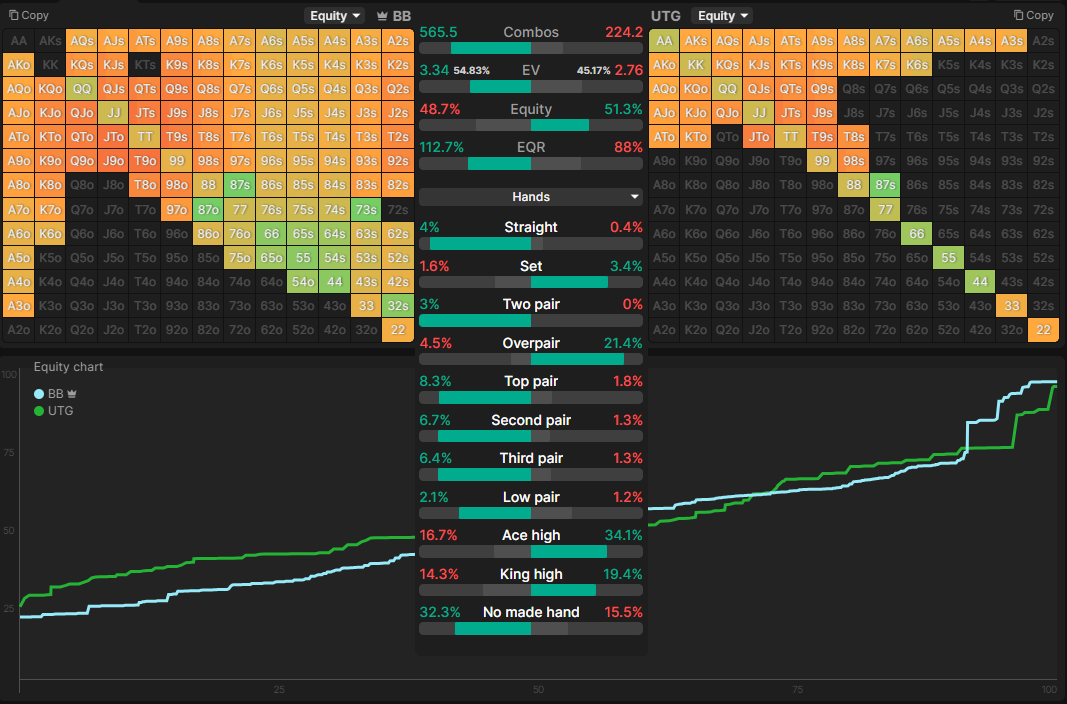
UTG, on the right, has a tight linear range of lots of strong Ax, Broadway, and pocket pairs. They have range advantage.
The BB on the left has such a wide range that they miss this board most of the time. They have no made hand more than twice as often as UTG, but they also have ten times as many straights, all the combos of two pair, more top pair, more second pair, more third pair and lots of combo draw hands like 34s.
UTG has range advantage, the BB has nutted advantage.
While looking at a solver, you can also check out the equity and EV of each player. This will also inform range advantage and nutted advantage. In this example, UTG has a 51.3% equity advantage, which is a slim advantage. But the BB makes 3.34BBs in EV whereas UTG only makes 2.26BBs.
Looking at the ranges, you also need to determine the shape of a range, which will inform the betting strategy.
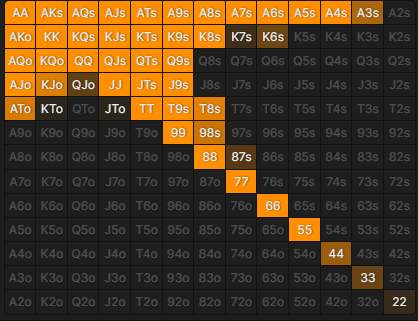
Linear Ranges
These are made up of all the strongest hands and a player with a linear range usually bets small with their whole range.
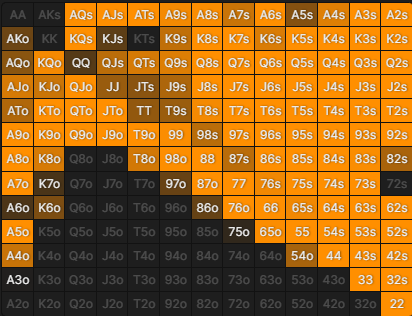
Capped and Condensed Ranges
Capped ranges tend not to have many strong hands in them. Condensed ranges only have medium strength hands in them. They both tend to be played passively, in a bluff catcher style.
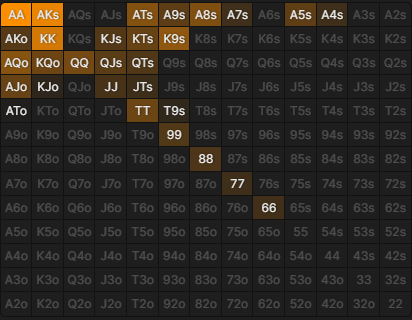
Polarised ranges
These tend to be made up of very strong hands and bluffs, without much in the middle. The betting strategy is usually to bet very big with bluffs and value, and to check the middle portion of the range.
That was a very simple introduction. We discuss range morphology and range advantage in much greater detail in GTO Poker Simplified.
Is this my board?
Once you have looked at the preflop ranges, an important question to answer on the flop which summarises range morphology and range advantage is, is this my board?
A hallmark of a bad player is to c-bet every single flop when it is checked to them. That may have worked in 2005 but it doesn’t work today.
When reviewing your hand, look at the preflop ranges, and ask yourself which player favours the flop? Once again, going back to these ranges:
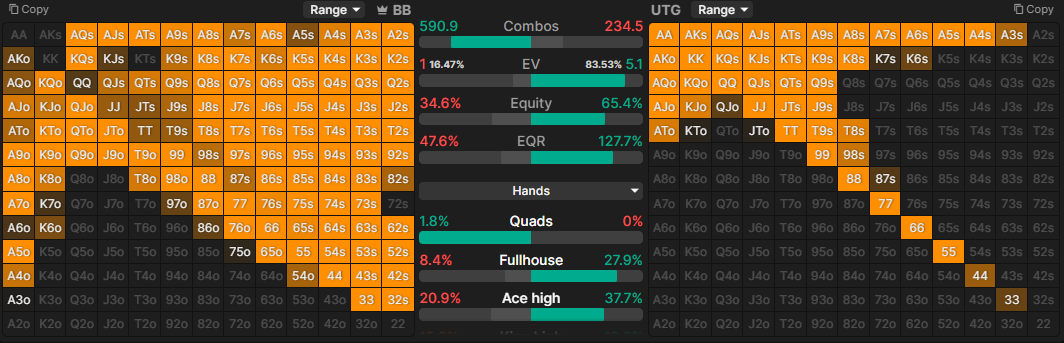
Whose board is this?
A♠2♥7♣
With no possible straight or flush draws, this surely favours UTG? The BB misses this board a lot, and UTG has lots of pocket pairs and Ax is a bigger proportion of their range.
What about this?
K♣9♣T♥
That also looks like it is UTG’s board, but it is a little closer.
What about this?
8♥6♣3♦
Now things are getting much closer. UTG has range advantage as they have lots of overpairs, but the BB hits this board a lot more.
What about this?
2♥3♥4♥
Now it’s very hard for UTG to have improved on this board but the BB could have connected with it in lots of ways.
Asking yourself whose board is a key question in a hand review and it is a question you should always ask yourself at the tables.
How does my range play?
This is perhaps the key differentiator between an amateur and a student of modern poker. It’s not about your hand, it’s about your range.
For example, this is the ranges for HJ vs SB, 50BB, single raised pot, on an A♥9♣2♦ flop:
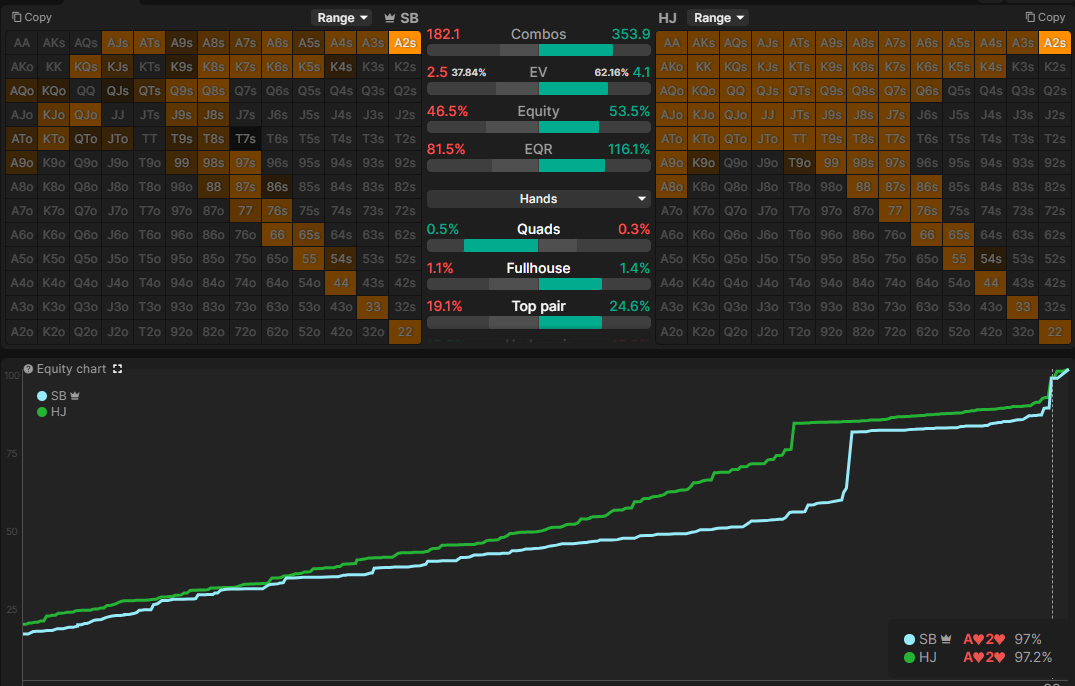
How would you play A2s if you were the SB here?
A lot of people might say they would lead out, because the HJ has lots of Ax that will call. However, spoiler alert, the solver checks 100% of the time here. Why?
Because the HJ has a significant range advantage on these boards, whereas the SB misses it more often. If you lead out here, the HJ folds all their Broadway, all their junk suited connectors and (in real life at least) probably folds some of their pocket pairs. However, if you check, this is what the HJ does:
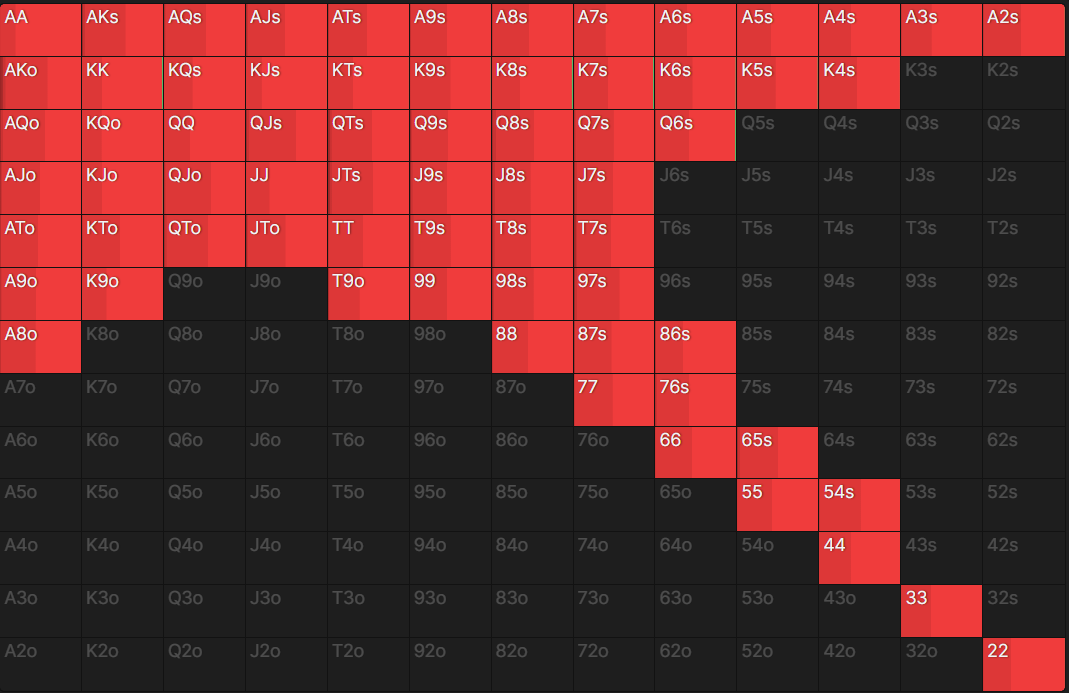

They bet their entire range.
This means you can now check/raise or slow play your hand, and guarantee at least one bet you would never have got with the weak portion of the HJ’s range.
This is a very simple example of why your hand and your range have different motivations, but generally what is good for your range is good for your outlier hands too.
Of course this does not mean that you should play every hand identically, just that you need to understand as a baseline what your range does. After that, look for what outlier hands do and see what lessons you can learn. For example, this is the SB response to the small bet:
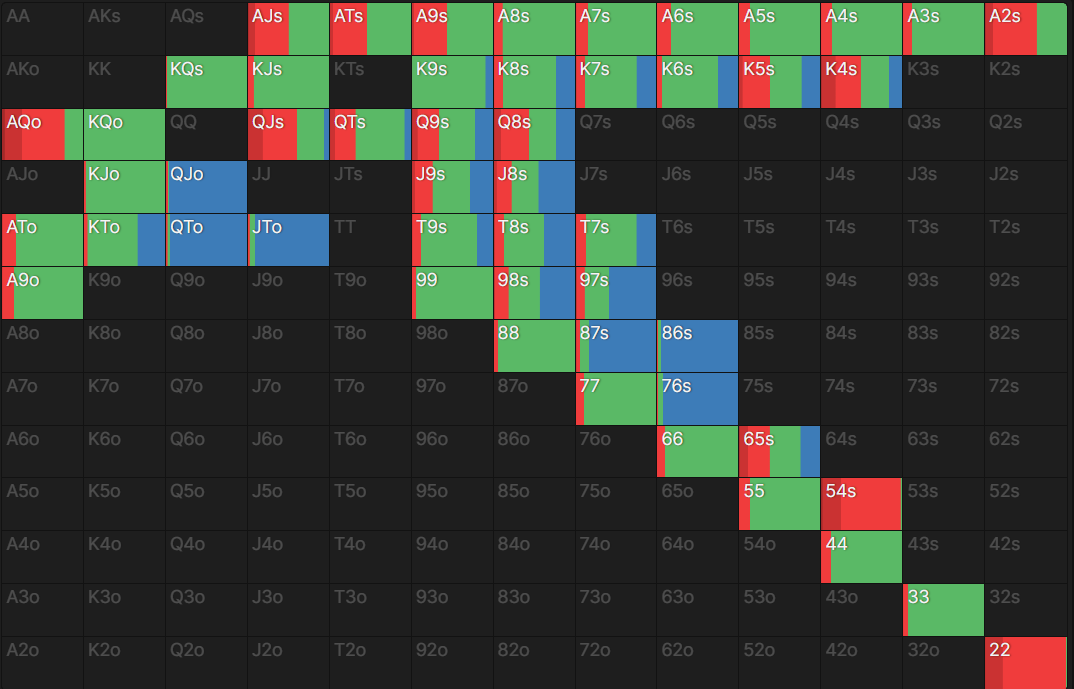

Now the range mixes up its actions. The worst hands fold, for obvious reasons. Some of the second worst hands raise, however. 65s, for example, has no showdown value, but is picked to bluff over ‘stronger’ hands like 87s, because it can make a runner-runner straight and/or a runner-runner flush (double back doors are frequently the best bluffs). The middle of the range mostly calls, to bluff catch. A2s calls a lot because it is not worried about being outdrawn but crucially it blocks the value hands – it’s hard for the HJ to have an A or a 2 – so it calls to keep in the bluffs. 22, for Quads, however, always raises because it unblocks Ax hands.
So one of the most important questions you can ask is what does my range do? Then follow that up with, what are the outlier hands that deviate from this strategy, and why?
This is an excerpt from Dara O’Kearney’s free ebook The Professional Poker Study Plan, which is a guide on how to study poker. You can get your free copy by filling out this form and a copy will be emailed to you.