Five Iconic WSOP Hands: #5 Ungar vs Brunson
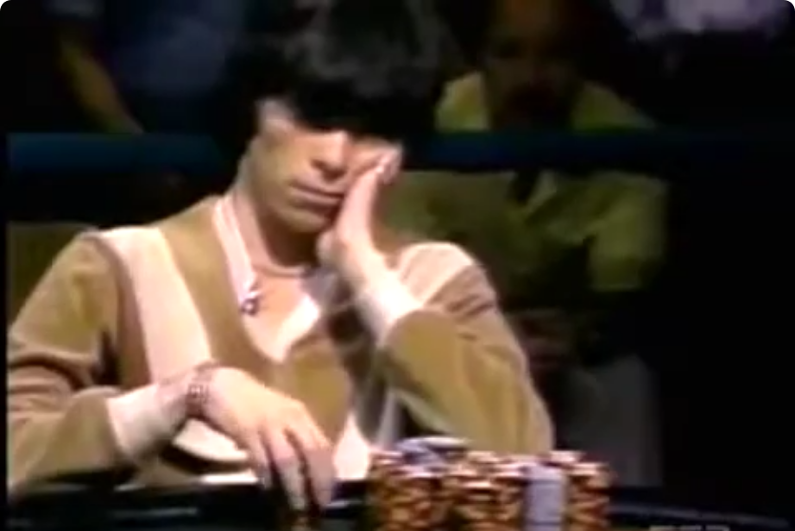 Our fifth and final iconic WSOP hand features Stu Ungar (pictured) beating Doyle Brunson heads-up to win the 1980 WSOP Main Event. (Image: YouTube / Grady Webster]
A poker player’s card sense
Immanuel Kant said: “Genius is the ability to independently arrive at and understand concepts that would normally have to be taught by another person.” More than a predilection or aptitude, it is a heightened intuition or instinct – a savant’s affinity, an artist’s virtuosity, a poker player’s card sense.
by the age of 13, he was skipping school to play cards
Born on the Lower East Side of Manhattan, New York in 1953, Stuart Errol Ungar was a gifted child with a natural proclivity for card games. His father Ido was a bookmaker and even though he didn’t want to expose his son to the world of gambling, there was no deterring little Stuey. At eight years old, he was already a formidable gin rummy player, hustling busboys out of their tips. He gambled with his bar mitzvah money and by the age of 13, he was skipping school to play cards and had a regular Friday night poker game.
When his father passed suddenly in 1967, Ungar dropped out of school to play high stakes gin rummy, drifting around the local gambling scene under the wing of influential mafia figure Victor Romano. At just five foot five and 100 pounds, Ungar would show up to games with a bodyguard and his opponents would invariably think that the muscle was the player who had brought his son along.
Total recall
One of Ungar’s greatest weapons was his eidetic memory. After two or three discards in gin rummy, he could say with enormous accuracy what his opponent held. Another great weapon was his mouth, as he goaded his opponents with arrogant table talk, inducing big money matches against the best gin players in New York, none of whom stood a chance against “The Kid” with total recall.
ability to quickly recognize patterns and learn heuristics from those patterns
Poker is not a memory game per se, but there are several ways that a photographic memory can help. It’s certainly crucial to be able to process the up cards in Stud games. Remembering perfectly how a villain played a previous hand can definitely inform how you could play a similar future spot. Also, and perhaps most importantly, in an era long before solvers, the ability to quickly recognize patterns and learn heuristics from those patterns would have given him an enormous edge.
In 1980, at the age of 26, Ungar played his first ever No-Limit Texas Hold’em poker tournament in the Super Bowl of Poker, finishing 34th out of 41 entrants. Later that year, he played his second in the then-record-breaking 73-runner WSOP Main Event. Payout structures were steep in those days with the tournament awarding $365,000, half the prize pool, to first. The fresh-faced Ungar made the final table and a final four that included Mayfair club legend Jay Heimowitz, three-time Main Event champion Johnny Moss, and back-to-back WSOP Main Event champion Doyle Brunson.
Dolly
In his youth, Brunson seemed destined for an athletic career, but a knee injury sabotaged his dream to become a player in the NBA. Switching the focus to his studies, he earned a Master’s in administrative education with the intention of becoming a school principal. A wily cardsmith, Brunson the student had a particular penchant for poker, paying his way through college with money won at the tables.
The allure of the game ultimately proved too much and, after a brief spell as a salesman after college, Brunson spent the 1960s on the road, joining a fraternity of Texas road gamblers. Most of the games in which he played were run by the mob, which meant that the risk extended beyond the table. Incidences of violence were commonplace, so he eventually settled down in Las Vegas.
Brunson was a regular at the WSOP since its inception in 1970 and, in 1976 and 1977, he took down the winner-take-all main events. Both times, he won the tournament by making full houses with Ten-Deuce, a hand which is still named after him to this day.
Super/Systematic
After winning two consecutive WSOP Main Events, Brunson became the face of poker. The game was growing in popularity, but there was very little literature out there and virtually nothing of a strategic nature. In 1978, he authored Super/System, giving readers an insight into how professionals approached the different poker variants, expounding on some of the core fundamentals and meta-game of the day.
the 605-page tome taught a generation of players how to fight fire with fire
It is not really possible to understate the importance of Super/System. Over the years, Brunson would regularly half-joke that writing it cost him a lot of money, as the 605-page tome taught a generation of players how to fight fire with fire. There was also an immediate effect with poker’s increased popularity resulting in record attendances at both the 1979 and 1980 WSOP festivals.
In 1979, Brunson picked up his sixth of what would ultimately be a ten-bracelet WSOP tournament career, sharing the honor with Starla Brodie in the $600 Mixed Doubles Seven Card Stud Event. The following year, he was in the running in “The Big Dance” again, but standing in his way heads-up was a brash, bellicose kid from New York who already had a reputation that preceded him and with whom Brunson was already familiar.
The Hand
Pre-flop
With the blinds 2000/4000 and a 500 ante, Brunson raised to 10,000 off a stack of 330,000 holding A♥️-7♠️. Ungar, playing 400,000, called with 5♠️-4♠️.
Flop
The pot was 21,000 and the flop came A♦️-7♦️-2♣️. Ungar checked, Brunson bet 10,000. and Ungar called.
Turn
On the turn, the pot was 41,000 and it came the 3♥️, so the board read A♦️-7♦️-2♣️-3♥️. Ungar led for 30,000 and Brunson moved all-in for 309,500. Ungar called with the nuts, needing to fade just four outs.
River
The river came the 2♦️ and Ungar was crowned the 1980 WSOP Main Event champion, winning $375,000 in prize money.
Analyzing the hand
Pre-flop
The pre-flop action is pretty reasonable although in Solver Land, the suited 5-4 combos get used as three-bets for board coverage and how it gets a lot of the dominating hands to fold.
Flop
Brunson is on record saying that he believed that he bet too small on the flop. Most of the players of the day had an unhealthy preoccupation with “protection,” or equity denial, as we would refer to it now. They looked to shutdown hands too early with big bets rather than make bet sizes that would induce mistakes from their opponents. In reality, Brunson’s 47% of pot bet was actually quite a bit bigger than advisable as this is a range bet spot, meaning he should have sized down. Ungar’s check-call with a gutter is definitely the right play as he has great implied odds if he hits his hand and he can bluff on a later street.
Turn
Having spiked his gutter, Ungar’s decision to lead out is interesting. A check would be the standard play, looking to check-raise to a Brunson second barrel.
In response to the lead out, Brunson should have just called with a view to calling most rivers or betting if checked to. By shoving so much, he gives a lot of the hands that he beats an escape path and he blows off any draws, rather than inducing a mistake by charging them.
Genius
Years later, when asked about the hand, Brunson broke it down similarly, adding how he felt that Ungar would have shut down on that particular river when the board was paired and both a flush and full house were possible. Even if Ungar had found a bet, it’s virtually certain that it would not have been for all of Brunson’s chips.
improving with every hand that he played in the tournament”
While he acknowledged his error, he also paid tribute to the genius of Ungar who he observed “improving with every hand that he played in the tournament.” “The Kid” was figuring out the game of No-Limit Hold’em on the fly, deciphering the strategy and divining heuristics in-game versus the best players of the day.
Genius is neither learned nor acquired. It is knowing without experience, perception without touch, risking without fear of failure. Ungar was never afraid and once said: “when the cards are dealt, I just want to destroy people.”
He was a natural and he proved it by not only defeating the legend that was Doyle Brunson in the 1980 WSOP, but by winning the Main Event two more times, returning one year later to defend his crown and then completing a famous comeback victory in 1997.