Atlantic Lottery profits and sports betting dip, iLottery…
The Atlantic Lottery Corporation (ALC) reported a slight dip in profits in the 2023-24 fiscal year despite 17% year-over-year growth in online lottery sales.
The ALC’s annual report for the 2023-24 fiscal year shows a drop of 1% or around $5.2 million in total net profit, down to $487 million, which President and CEO Patrick Daigle said this week was “expected” and “by design.”
The crown corporation posted gross revenue of $872 million, $28 million more than last year’s figure. But expenses of $385 million took a small bite out of the profit margin. Daigle said some of that increased expenditure was a result of “a catch-up year” of infrastructure renewals and improvements post-pandemic, including new in-store lottery terminals.
“We’re making investments in the business that were planned and at a time when we knew that our revenues were increasing and we could afford to make those investments. We’re very happy with the year,” Daigle said Wednesday. The ALC said in a statement that its actual profit represents an increase of $1.6 million above the budgeted profit.
That $487 million in net profits was distributed back to the four Atlantic provinces: $161.7 million to Nova Scotia, $151.2 million to New Brunswick, $147.3 million to Newfoundland and Labrador and $26.8 million to Prince Edward Island. In every province other than Nova Scotia, that amount fell from last year.
While retail sales were flat, Atlantic Lottery made progress with its digital operations.
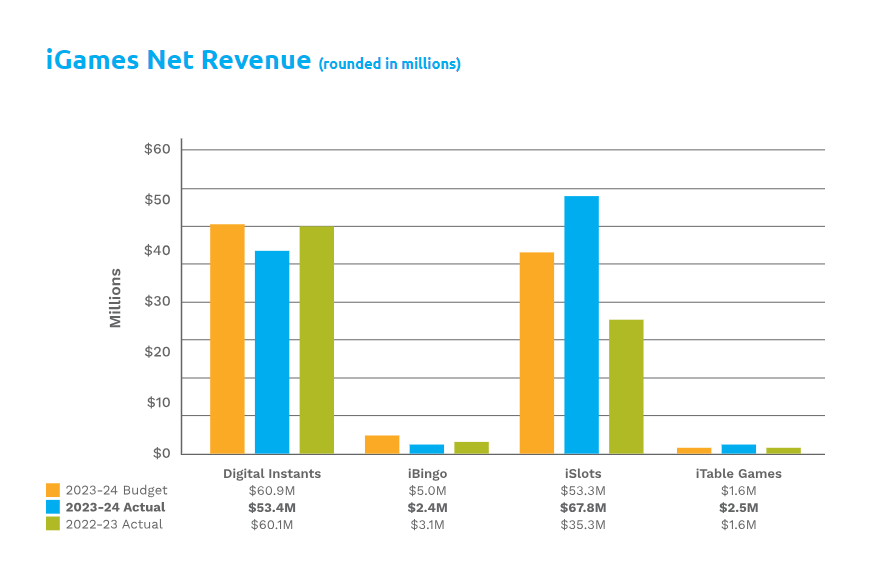
Gross gaming revenue for its iLottery line of business increased by $24.7 million (17%) year-over-year in what was its first full year of online operations in the most profitable Atlantic province of Nova Scotia. Meanwhile, net revenue from iGames, including einstants, and online table games, slots and bingo, reached $126.2 million in 2023-24, up 26%.
The growth was boosted by new significant gaming supplier partners such as NeoGames as well as the launch of online casino in Newfoundland and Labrador.
“We’re trying to future-proof a lottery business, and one of the ways we’re going to do that is through digitization,” Daigle told attendees at this year’s Canadian Gaming Summit back in June. “We worry about relevance to the under-35 segment, we worry about traffic patterns and retail, and we worry about jackpot fatigue… For the under-35s, it’s about meeting them and that is absolutely via the digital channel. It’s wrapping experiences around lottery for them.”
Although the impact won’t be seen until next year’s results, ALC has already taken notable steps in the 2024-25 fiscal year, such as agreeing a deal with IGT to launch cloud-based games and solutions and launching major studio Evolution’s games for the first time this fall.
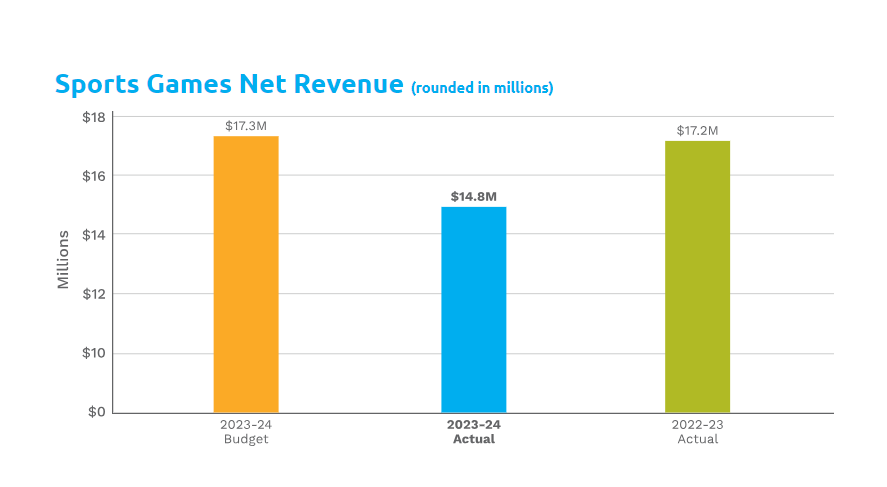
However, ALC underwhelmed in terms of sports betting performance.
On the sports wagering side, net revenue was down 13.4% to $14.8 million, significantly lower than was budgeted for in the fiscal year. ALC noted that digital revenue made up 77% of all sports betting sales. Retail sports betting sales were down 3%.
Daigle, always a vocal critic of the presence of unregulated gambling operators in the Atlantic region, cited research data at CGS in June that suggests that up to two-thirds of consumers don’t know that such operators are unlicensed.
He reaffirmed his stance again in this year’s report.
“Our commitment to healthy play is a key differentiator that sets Atlantic Lottery apart from illegal gambling operators,” he wrote. “Some Atlantic Canadians may not realize that Atlantic Lottery is the only legal provider of online gaming and sports-betting products in our region. Unfortunately, nearly $200 million leaves Atlantic Canada each year as a result of the illegal gambling market, allowing private operators to profit instead of benefiting our local communities.”
The ALC stated in its report that its online gambling operations hold a 22% market share of total online betting and gaming activity in the Atlantics.
In Nova Scotia, at least, it now has one fewer competitor. Prominent Antigua and Barbuda-based operator Bodog no longer operates in the province’s grey market after closing down its business in the province at the start of October. “Lack of public awareness of the legalities has lent an air of legitimacy to these operators and misleads the public, so we are encouraged to hear that Bodog will be ceasing illegal operations in Nova Scotia,” Daigle told Canadian Gaming Business at the time.